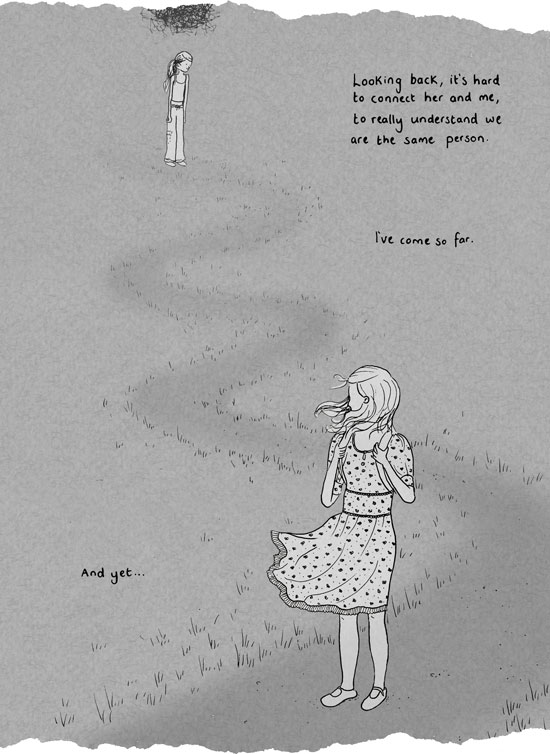
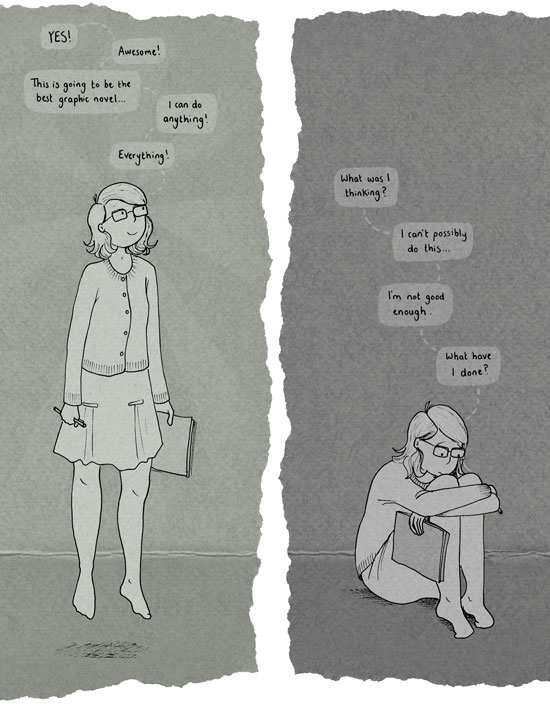
Drafts 2, 3, 4…

Never Good Enough

In truth I don’t know how many drafts I went through. Perhaps four or five of the entire book, but some sections were certainly reworked much more than that. Some sections have changed very little from that first draft, others are unrecognisable.

Perhaps I don’t need to tell you that I’m a perfectionist. It goes hand in hand with anorexia (though I’ve recovered from one, I’m not sure there’s any hope for the other). With that in mind, I’m sure you’ll understand that I was never going to feel ready. To go through one final draft and decide “That was it, it’s finished, now I’m ready to start drawing,” was never going to happen.

I know that’s how my brain works, but still, I was expecting the final draft to be more…done.

What decided the final draft, in the end, was time. I wanted this book to come out in 2013, the year I turn 30, and therefore I needed to set pen to paper in 2012. Or perhaps earlier than that, but it was 2012 already so that would have to do.
THE WALL CHART

wall-chart

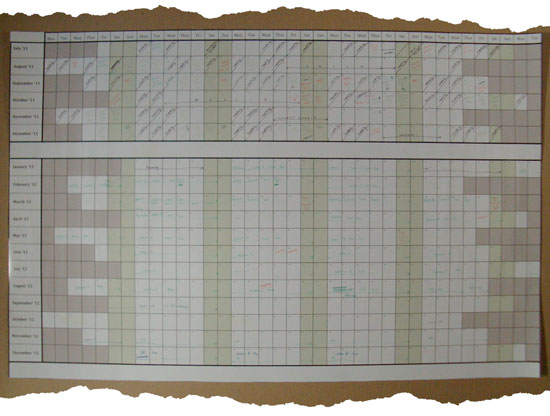
With the time for faffing drafting and redrafting over, I had to find a way not to feel overwhelmed by the sheer volume of drawing ahead of me. I used a very simple formula: divide the number of pages that need drawing by the number of days I have to draw (allowing myself the occasional weekend, and a week’s holiday halfway through). The number I came up with was 12 pages a week. So long as I could stick to that target, I could stop worrying about the whole massive thing and worry only about 12 pages at a time.

This wasn’t quite enough to settle my nerves, so I made a wall chart breaking down exactly when I would tackle each section. Seeing it all laid out in front of me, with clearly enough space to hit the deadline, felt very comforting.

It’s perhaps important to acknowledge that this extreme level of meticulous planning is not dissimilar to the way I used to plan my meals when I was anorexic…

ABOUT THAT FIRST DRAFT…

First Draft 1

I felt really embarrassed by my first draft.

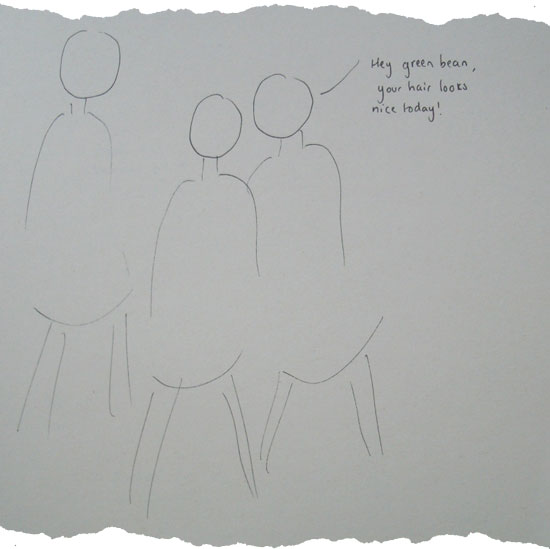
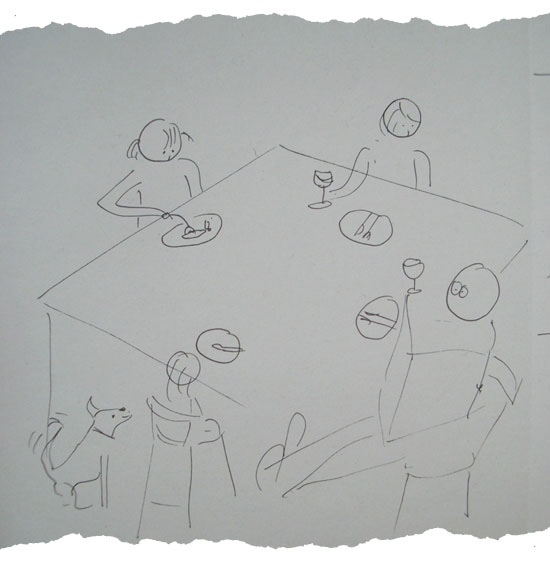
First of all, the drawings! People are often amazed when I say I knocked out a first draft in three weeks, but that was only possible with the most basic, gestural drawings. I was mostly only drawing for myself, and I knew which characters were which, so they had very few distinguishing features. It was really just about getting the bare minimum on paper to give the sense of the structure and pacing of a scene.  There was no point in spending any longer on what were, essentially, disposable drawings. I conveniently forgot I would have to show them
to one of the most prestigious publishers in the country!

First Draft 2

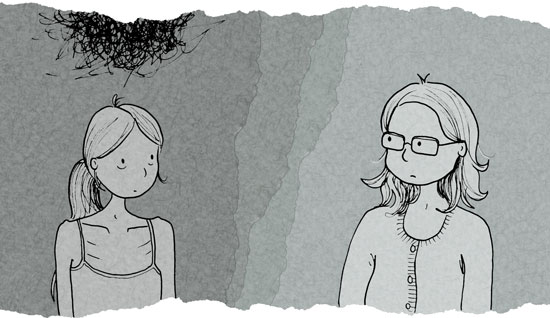
The best parts of it I could only just tolerate to read. For the most part it made me cringe. It was clumsy, obvious, clichéd and lacking the subtlety and emotional depth that I wanted to create. I sound like I’m berating myself and being incredibly harsh, but actually the process was just coming to accept that this is what a first draft has to be. As Graham Linehan said (in an interview for Charlie Brooker’s Screenwipe), the first draft is just toilet paper.

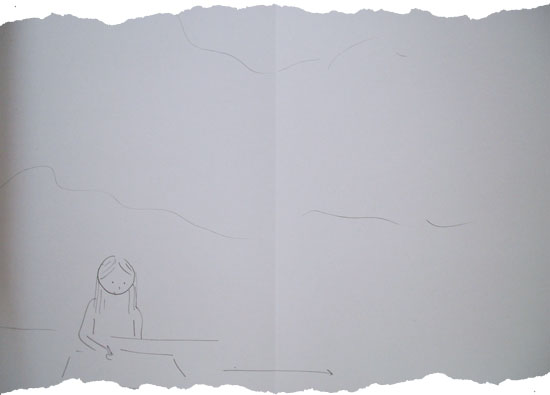
In addition to the (large) bits I felt were complete rubbish, there were the bits I left blank. So much of the story had been unbearable to sit with, I’d just about managed to get a sense of how long those scenes took in the story. I’d not been able to to plan to any extent beyond that, to even begin to draw what had happened. There were panels, pages, and even great chunks up to 14 pages long that had no drawings on at all.

First Draft 3

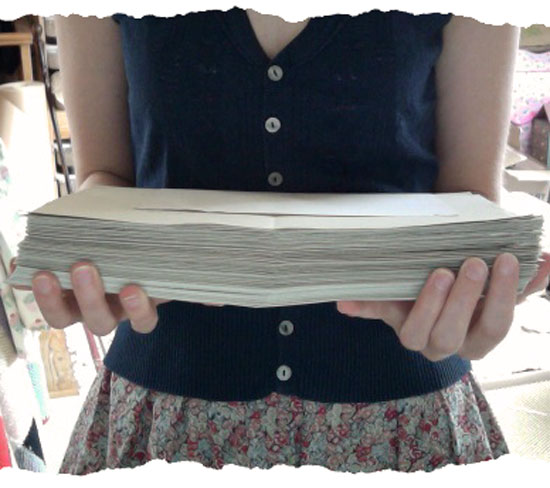
So in February 2010 I sent Jonathan Cape 500 pages of work that made me cringe, and prepared myself for hearing feedback on work in such a raw state that I would never normally show it to anyone.

FIRST DRAFT

This post is the last in a series about a writing retreat I took in 2010. Please click here if you’d like to read from the beginning.First Draft

At the end of three very challenging weeks, after a lot of sketching and stressing and screwing up paper, I did indeed manage a first draft.

Jonathan Cape were not going to know what had hit them.

SITTING WITH IT

What happened during those three weeks tested my stability in recovery. The flashbacks, which I’d had to induce by choice, were indeed overwhelming as I had feared, and I was completely alone with them. With my mind finally going to the places I needed to write about, I couldn’t run away, distract myself, eat (or not eat) as I always had done before. I had to sit with it, sit with it, sit with it.

And write it down.

Write It Down

This post is the fourth in a series about a writing retreat I took in 2010. Please click here if you’d like to read from the beginning.

TRIGGERS

For years I avoided triggers. For me, that meant avoiding anything specifically relating to eating disorders and recovery, any information about dieting or weight loss; anything that might upset my long-fought-for fragile balance of not hating my body to the point of wanting to obliterate it.

It also meant avoiding sex. Not only the physical act but books, movies, anything that reminded me of its existence. Sometimes even the word was enough to trigger a flashback, and words like rape or abuse had even more power. (As a result of thinking about triggers, I’ve given some thought as to whether I should give ‘trigger warnings’ for posts on this blog. This cautionary note explains my feelings on the matter.)

When I was on my writing retreat and finding it difficult to reconnect with those emotions by choice, I decided my best way forward was to try and trigger myself. I set about reading a stack of books I’d diligently avoided for years…

Triggering Myself

It worked.

This post is the second in a series about a writing retreat I took in 2010. Please click here if you’d like to read from the beginning.

RECONNECTING

This post is the second in a series about a writing retreat I took in 2010. Please click here if you’d like to read from the beginning.

Hard to Reconnect

Despite my fears, what I found at the start of my retreat was that it was hard for me to be affected by my past, even when I wanted to be. Perhaps I’d left it further behind than I’d thought. Perhaps I’d become so used to avoiding the difficult stuff as a way of protecting myself from the emotions it could stir up. I could reason out why I had suffered from an eating disorder, but I couldn’t remember what the suffering had felt like. I found it surprisingly hard to reconnect. I needed to find a way to remind myself.

In the earlier stages of my recovery, I had written in a journal every day, sometimes several times a day. Years later, when I was having one of my moments when I decided that writing a book would be a stupid cliché, and I wanted to forget it all had ever happened, I destroyed every single one of them…

Burning Ceremony

I wish I hadn't done that...

FEARS

This post is the first in a week-long series about a writing retreat I took in January 2010, to work on the first full draft of Lighter Than My Shadow.

Looking Back

I was afraid of being alone with all of my ‘stuff.’ I was afraid that putting myself back into an eating disordered mindset in order to write about it would make the behaviour all too tempting. I was afraid that in three weeks without anyone to check on me, I would find myself fully entrenched in a relapse.

I was afraid that I wouldn’t be able to cope with flashbacks or anxiety attacks, and that the pain would become overwhelming and result in a complete nervous breakdown.

I was afraid that I wouldn’t be able to work at all.

This illustration was created in 2009, before I signed the contract with Jonathan Cape. Some variations on the concept have appeared in the book, but this exact image didn’t find a place. However, it seemed perfectly fitting for this blog post.

AVOIDANCE

I'll just write this email...

For a long time, I dabbled. Even after signing the contract and everything becoming real and official, I think there was a level of denial. The project still felt overwhelmingly big, the deadline incomprehensibly far away. There was always something else I found to do that was smaller or had a more immediate deadline. I told myself “I’ll just do this [insert justification here] and then I’ll really get started.” It took a few months of still not starting for me to notice the pattern.

Clearing Space

I decided the best way for me to clear a space was to go away. Away from my computer, away from my part-time job, away from my friends and family and other work. To be completely alone with just pens, paper and the story in my head, and no choice but to get the heck on with it. I went for three weeks (next week I’ll be blogging about what happened while I was there).